

The Room Went Silent. I Thought That Was the Whole Story.

It was early 1998. I was in my mid-twenties, working at Timex, and I had just landed on a project with Disney for products in duty-free shops. It was the kind of opportunity that makes a young designer sit up straight.
Then I saw the style guide.
It was thin. Limiting in ways that didn't serve the work. I stood in a room full of people who clearly thought the same thing, but said nothing. I said it out loud: "This style guide sucks."
The room went silent.
My boss later told me that I wouldn’t be attending any more meetings at Disney.
I’ve carried that same story for thirty years; evidence that I was too much, too direct…not professional enough. That I had walked into a real opportunity and blown it by simply saying what everyone else was thinking.
Here's what I conveniently forgot to remember: that wasn't the end of the story.
Here's the Part I Left Out
We did great work anyway.
Duty-free retail has its own logic; less brand rigidity, more room to breathe. Travelers in an airport aren't browsing a flagship Disney store; they're moving fast, making impulse decisions, grabbing something joyful for a kid back home. The constraints that felt limiting in the conference room actually created space at the point of sale.
I've still got those watches; a Mickey and a Minnie, molded-rubber bands with gloves and shoes and hearts, bright and bold and completely of their moment. Not sophisticated design. Exactly right design. The kind of work that knows its audience, knows its context, and delivers on both without apology.
The limitation became the creative brief. The incomplete guide became an invitation.
I just couldn't see that part yet. I was too busy being 25 and right about something.

Then I Did the Thing That Actually Mattered
Here's the part I usually keep to myself.
After the room, after the silence, after being told I didn’t need to attend any more meetings, I noticed something as I was working to create art for a particular case. Disney’s rule that Mickey's ears always had to show: full face, round ears, immediately recognizable on every product, every licensee, no exceptions. It wasn’t working.
I realized that Mickey was recognizable without his trademark ears.
So I drafted an email to the design team at Disney. I laid out my case: that Mickey was iconic enough to be recognized without his ears. That restraint could be its own kind of magic. That sophistication didn't have to mean unrecognizable.
They heard me; they said yes.
I was 25.
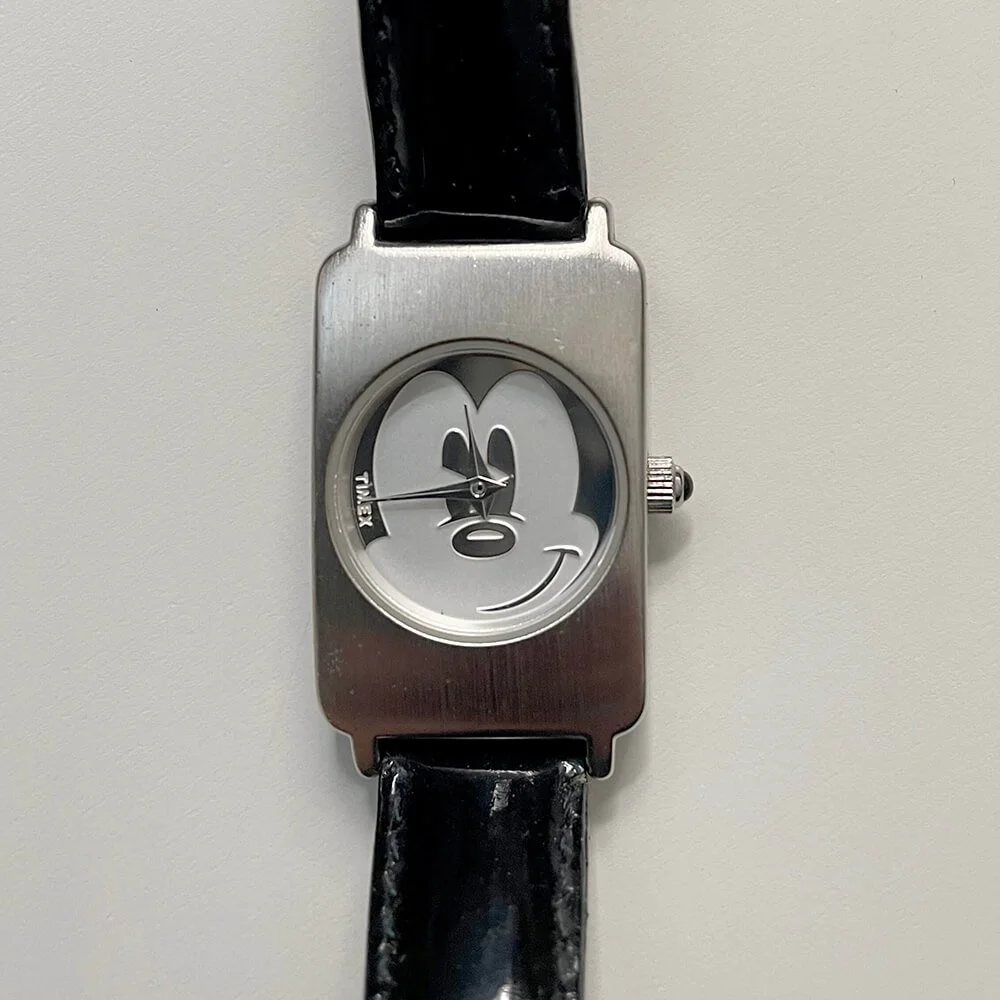
The watch I made from that conversation is the one I'm most proud of to this day. Brushed- steel, rectangular case. Mickey's face fills the entire dial, etched, clean, and confident. No numbers. No clutter. Just that smile, unmistakably him, in a format nobody had tried before.
I called it “Subtle Mickey.” (The watch is pictured at the top.)

The Stories We Mislabel
For twenty-five years, I held the shame story: The room that went silent after I said, out loud, that the style guide sucked. The proof that speaking up costs you something.
And all of that is true. It did cost me something, at least in that room, on that day.
But I left out the part where I found another door and walked through it. The part where I made my case quietly, professionally, and persuasively to the exact people who needed to hear it. The part where a 25-year-old from a small town in Iowa convinced Disney to do something they'd never done before.
I filed that part under "lucky." I filed the loud part under "cautionary tale."
I had it exactly backwards.
What Reframing Actually Looks Like
Reframing isn't spin. It's not telling yourself a prettier lie about something that hurt.
It's asking: what else is true about this moment?
The shame came from measuring that room against the wrong standard; the standard of keeping everyone comfortable, of not disrupting things, of being easy to work with. I had been trained to optimize for that standard my whole life.
But that was never my actual standard. My standard has always been: is it true, and does it serve the work?
The foghorn moment in the conference room? That was the instinct without the craft. The email to Disney? That was the instinct with the craft. Both came from the same place; a person who saw what was possible and couldn't pretend otherwise.
One of them got me pulled from a project. The other one made something that still sits in my drawer thirty years later, still smiling.
The Superpower You Might Be Apologizing For
I work with people who move fast, see clearly, and have spent years over-explaining their vision to people who couldn't keep up. People who have been told, in one way or another, that they are too much.
I want to ask you something: what's the story you've been carrying as a shame story?
The time you spoke up, and the room went quiet. The moment you said the true thing, and someone made you pay for it. The version of yourself you learned to dial back because it made people uncomfortable.
Is it possible that version of you wasn't the problem?
Is it possible you were operating ahead of the rooms you were in?
The world is better and more beautiful with good design.
I believe that completely. But I also believe the world is better when people stop apologizing for seeing clearly, speaking honestly, and refusing to pretend a bad style guide is fine.
Your instinct might be exactly right. The delivery is something you can learn. The vision, that part you were born with.
Subtle Mickey has been sitting in my drawer for twenty-five years, waiting for me to tell the whole story…and now, I have.
If you’ve spent years making yourself smaller in rooms that weren’t ready for you — and you’re wondering whether your brand is finally telling the whole story — I’d love to talk. Let's connect.
Aurelie Gallagher is the designer behind Irish Eyes Design, a graphic design studio based in the Chicagoland area, working with clients everywhere. She specializes in brand identity, print design, and Squarespace websites.
“Great design starts with knowing yourself first.“